

Solutions That Stick
Bridging Big Ideas and Real-World Association Impact
Where association innovation gets practical
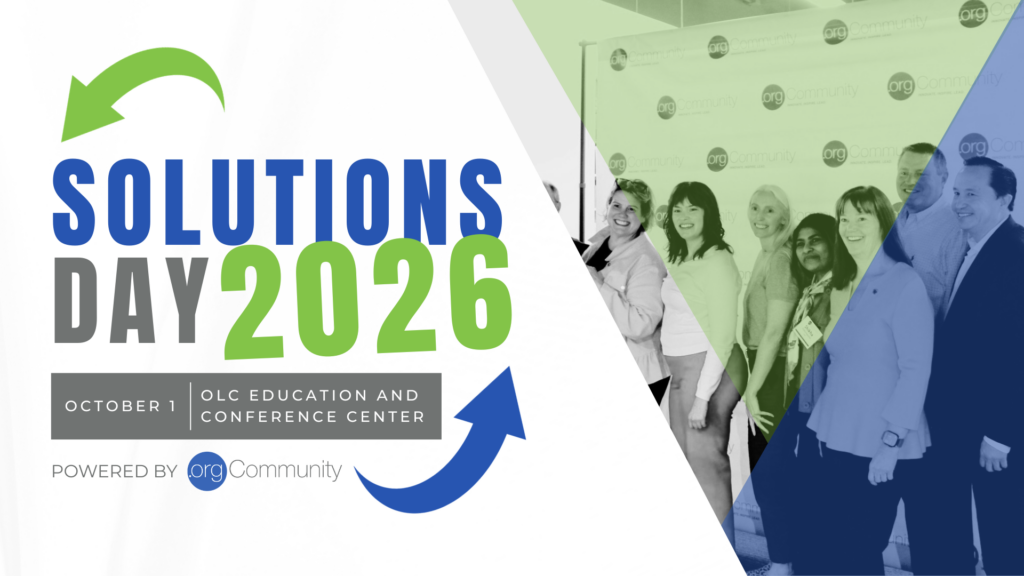
Solutions Day, October 1, 2026
OLC Education and Conference Center, Rosemont, IL
8:30 AM – 4:00 PM + Happy Hour
Why Attend?
- See practical innovation from across the association sector — pilots, products, and strategies you can evaluate and act on
- Hear from keynote speaker Garth Jordan on why Most professional associations need to invest in new business models by starting with rebuilding their value proposition.
- Leave with a closing keynote from Sherry Budziak on what transformation actually requires from leaders who want it to stick
- 20-minute talks respect your time and sharpen every session
- A curated day designed specifically for association professionals — nothing recycled from generic corporate conferences
- Continue the conversation at the happy hour following the main program
Keynote Speakers

Opening Keynote: Garth Jordan
Chief Executive Officer, MBA, CSM, CSPO, AAiP Therapy Dog Organization - Alliance of Therapy Dogs
The professional association was one of the most elegant organizational inventions in American history. But it was built for a vanished world: one of information scarcity, geographic limitation, and no alternatives. That world is gone. The model remains.For thirty years, the data has told the same story—flat and declining membership, a dues-to-revenue inversion no one ever voted on, and a sector quietly unconvinced of its own worth. The response has been nearly universal: run the model better. Not differently. Better.
This session argues the model itself is the problem—not because the people running associations are failing, but because the entire professional infrastructure of the sector, its training, its credentialing, its peer communities, is built to execute an inherited architecture rather than question it.
The organizations that have broken through share one discipline: they chose to focus on value. Deliberate, strategic, and sometimes costly—because they gave something up to get there.
Drawing on fifteen years leading and transforming associations across five industries, Garth Jordan presents a methodology that starts with what the profession truly needs and builds through a value-first lens—one that ultimately dictates the business model, instead of the other way around.
Come ready to think about your organization differently.

Closing Keynote: Sherry Budziak
Founder, .orgCommunity
Sherry Budziak closes the day with a direct challenge and a practical framework: what does it actually take to lead transformation that sticks? Drawing on 11 years of building Solutions Day and working alongside association leaders, Sherry will leave attendees with clear thinking, honest reflection, and actionable next steps.
Who Should Attend?
CEOs and Executive Directors
CIOs, CTOs, and COOs
Strategy, membership, marketing, and operations leaders
Innovation-focused board members and senior staff
Any association professional responsible for leading or implementing change
Agenda
included for all registrants
Welcome and Introduction with Sherry Budziak and Kevin Ordonez
Speaker: Garth Jordan, MBA, CSM, CSPO, AAiP, Chief Executive Officer, Alliance of Therapy Dogs
Eleven percent. That’s the share of associations that describe their own value proposition as very compelling — not to outsiders, to themselves.
The professional association was one of the most elegant organizational inventions in American history. But it was built for a vanished world: one of information scarcity, geographic limitation, and no alternatives. That world is gone. The model remains.
For thirty years, the data has told the same story — flat and declining membership, a dues-to-revenue inversion no one ever voted on, and a sector quietly unconvinced of its own worth. The response has been nearly universal: run the model better. Not differently. Better.
This session argues the model itself is the problem — not because the people running associations are failing, but because the entire professional infrastructure of the sector, its training, its credentialing, its peer communities, is built to execute an inherited architecture rather than question it.
The organizations that have broken through share one discipline: they chose to focus on value. Deliberate, strategic, and sometimes costly — because they gave something up to get there.
Drawing on fifteen years leading and transforming associations across five industries, Garth Jordan presents a methodology that starts with what the profession truly needs and builds through a value-first lens — one that ultimately dictates the business model, instead of the other way around.
Learning Objectives
- Evaluate the assumptions underlying the traditional association business model against thirty years of membership and revenue data.
- Analyze their own organization’s value proposition using a value-first framework that begins with what the profession needs rather than what the association already offers.
- Identify the strategic trade-offs and organizational commitments required to shift from executing an inherited model to designing a value-driven one.
Speakers: Amanda Decker, CAE, Membership Director, the Association for Information Systems (AIS); Kelly Lakas, OnyxPoint Systems
When AIS needed to showcase a modern AI experience at its Annual Meeting, OnyxPoint helped turn its technical library into a searchable, citation-backed, and generative AI-rich member benefit in just three weeks.
This session will share how AIS evaluated AI responsibly, worked through questions from its AI task force, and launched a pilot that made 5,000 papers of trusted research easier for members to access and use. After the successful pilot, OnyxPoint and AIS worked to expand the AIS AI assistant to over 70,000 papers and refine the output using feedback from key members.
Attendees will hear how an association can move quickly on AI without giving up control of its content, weakening trust, or overburdening staff and IT.
Learning Objectives
- Describe a phased approach for evaluating and piloting an AI-enabled member benefit on a compressed timeline.
- Identify the governance, content-control, and member-trust questions an internal AI task force should resolve before launch.
- Apply pilot feedback methods to scale an AI tool from a limited content set to a full library without overburdening staff and IT.
Speakers: Greg Cohen, American Society of Landscape Architects; Jason Vance, re:Members; Carole Herzog, re:Members
Most associations treat their AMS as the end of the data story. Greg Cohen, at the American Society of Landscape Architects, sees it as the beginning.
By connecting re:Members AMS to its AI tools, ASLA extended its data infrastructure to unlock deeper insights, reporting, and innovation. In this session, Greg shares what prompted the shift, how ASLA approached it, and what associations should be asking about their own data strategy.
If you’ve ever wondered what’s really possible once your data stops living in a silo, this is the conversation to hear.
Learning Objectives
- Distinguish between operating an AMS as a system of record and extending it into a system of intelligence.
- Identify the diagnostic questions that signal an association’s data is siloed and constraining insight and reporting.
- Outline the sequence of steps and internal conditions required to connect AMS data to analytics and AI tools.
Speakers: Taylor Albano, VP of Education and Training, American Supply Association (ASA); Bill Sheehan — Head of Association Strategy, D2L
Associations are under increasing pressure to deliver education that helps members develop talent, address workforce challenges, and create lasting value.
Join Taylor Albano, VP of Education and Training at the American Supply Association (ASA), in conversation with D2L’s Bill Sheehan, as they discuss ASA’s approach to modernizing learning, supporting workforce development, and creating engaging educational experiences for members.
Hear lessons learned, practical strategies, and insights that any association can apply to strengthen its learning programs.
Learning Objectives
- Describe how one association modernized its learning portfolio to address member workforce and talent development needs.
- Identify practical strategies for increasing engagement and completion in association education programs.
- Assess their own learning program against the lessons learned and pitfalls shared in the case study.
Speaker: Conor Cunneen, The Irishman Speaks
Whether you believe the Gallup poll that only 30% of US workers are “engaged” or not, there is no doubt that improving employee engagement will enhance not only the workplace environment but also the bottom line.
Improved employee engagement will not happen just because you want it to happen. In this compelling and engaging program, Conor Cunneen of Irishman Speaks will outline how the Gift of GAB (Goals, Attitude, Behavior) provides a powerful, memorable framework to improve employee engagement, the workplace and the bottom line.
Learning Objectives
- Explain how clear goals, positive attitudes, and constructive behaviors influence employee engagement and workplace performance.
- Apply the Gift of GAB framework to identify practical opportunities to strengthen engagement within their teams.
- Develop one actionable approach for improving the workplace environment and supporting stronger organizational results.
Speakers: Heidi (Schultz) Mitchell, Sr. Trade Show Manager, National Safety Council: Rich Vallaster, Senior Director of Industry Relations and Thought Leadership, Momentive Software
For years, associations have watched dues shrink as a share of revenue. This session argues the inversion is the clearest signal members have ever sent about where they actually find value — and the smartest organizations are building on it rather than fighting it.
In 20 minutes, hear from an association executive who pairs a firsthand case study with industry research to show how events are not only carrying a larger load of non-dues revenue but also deepening engagement and attracting the next generation of members.
You’ll leave with strategic and tactical ideas to turn your events into your association’s front porch: the place where value, revenue, and future members all arrive first.
Learning Objectives
- Interpret the long-term shift in dues-to-non-dues revenue as a signal of where members find value.
- Examine case study and industry research evidence connecting events to non-dues revenue, engagement, and next-generation member acquisition.
- Identify strategic and tactical changes that position events as the entry point to the association’s overall value proposition.
Speakers: Artesha Moore, FASAE, CAE — President & CEO, Association Forum; Greg Pollack — VP, Sales Enablement & Engineering Onboarding, Higher Logic
Great ideas do not gain traction because they are perfectly polished. They move because people know how to explore, challenge, pitch, test, and refine them.
In this Solutions Day session, Artesha Moore and Greg Pollack will go behind the scenes of how a technology company turns early ideas into real experiments. Attendees will leave with practical ways to build curiosity, strengthen their innovation muscle, and keep pushing ideas forward until something sticks.
This is not about getting a “yes” every time. It is about building an organization that knows how to learn its way forward.
Learning Objectives
- Identify the conditions that help new ideas gain traction inside an organization.
- Apply practical methods to explore, pitch, pressure-test, and refine an emerging idea.
- Use small experiments to learn quickly, reduce risk, and build momentum toward a larger solution.
Speakers: Travis Cheatham — Director of Technology Operations and Digital Solutions, American Association of Clinical Endocrinology; Kimberley Jacques, Vice President of Education, College of Healthcare Information Management Executives (CHIME); Mike Smith, Director of IT, Precast/Prestressed Concrete Institute
Most association AI initiatives do not fail on technical grounds. They stall because the organization has no reliable path for moving an emerging idea from individual interest to institutional commitment. This moderated panel examines that path directly.
Several members of the AI Accelerator Mastermind share what they learned over 26 weeks in the cohort — not theory, but the record of what happened when they attempted real AI initiatives inside their own associations.
Panelists discuss how they assessed internal conditions before making a proposal, how they framed the case for executive leadership and staff, how they pressure-tested ideas against operational and reputational risk, and how they used limited-scale experiments to generate evidence, reduce exposure, and build support for broader implementation.
Learning Objectives
- Identify the conditions that help new ideas gain traction inside an organization.
- Apply practical methods to explore, pitch, pressure-test, and refine an emerging idea.
- Use small experiments to learn quickly, reduce risk, and build momentum toward a larger solution
Speaker: Sherry Whitaker Budziak, CEO, .orgSource
Close Solutions Day with an interactive keynote featuring Sherry Whitaker Budziak, co-author of RUG: How to Move What You’re Tripping Over and Lead with H.E.A.R.T. Inspired by the book’s Reimagine chapter, this session challenges C-level association executives to look beyond the systems, assumptions, and familiar ways of working that may no longer serve their organizations or members.
Through guided reflection and conversation, participants will identify the “rugs” that can quietly constrain progress—from outdated expectations to legacy processes—and consider what becomes possible when they lead with greater clarity, courage, and purpose. Together, attendees will reimagine how their associations can create relevant member value, strengthen culture, and move from insight to meaningful action. The session reflects RUG’s emphasis on naming what is holding us back and taking small, practical steps forward.
Learning Objectives
- Recognize outdated practices or assumptions that may be limiting innovation.
- Apply a reimagining lens to member value, operations, education, and technology.
- Identify one concrete next step to move a future-focused idea into action.
included for all registrants
Approved CAE credits: 5.50
Our Partners


Become an .orgCommunity Partner Today!
Your LOGO HERE!
Becoming a sponsor of .orgCommunity is a unique opportunity to connect with C-level association executives who are actively seeking solutions to industry disruption. By aligning with .orgCommunity, your company can become a valued partner in their transformation journey.
Contact us for details!
Participants will earn up to 5.50 CAE Credits